
Journaling Without Perfectionism: Letting Go of the Pressure to Get It Right
Beautiful journal pages can be lovely to look at. Neat handwriting, carefully chosen photos, washi tape, thoughtful layouts. They can be inspiring, but they can also quietly make us feel as though our own journals should look that way too.And suddenly, something that was meant to feel calming becomes another thing to get right.
If you have ever avoided your journal because your handwriting felt messy, missed a few days and thought you had failed, or wondered whether you had anything meaningful enough to write, this is your reminder:
Your journal does not need to be perfect to be worthwhile.
Your journal is not a performance
A journal is allowed to be ordinary. It can contain beautiful pages, but it can also contain crossed-out words, rushed handwriting, unfinished thoughts and entries written in five minutes before bed.
You can simply write: Today was busy. I’m tired. I had a really good cup of tea this afternoon. That still counts. In fact, those small details may be exactly the ones you are happiest to rediscover years from now.
Let go of beautiful-page pressure
There is nothing wrong with enjoying a beautifully decorated journal. Adding photographs, paper, stickers or favourite pens can be part of the pleasure. But decoration does not have to be a requirement. Some days you might spend an hour creating a page you love. Other days you might write three lines in black ink and close the journal again. Both pages belong in your journal. A lived-in journal will naturally be inconsistent. Different pens, different moods, different amounts of time. Perhaps that is part of the beauty.
You are allowed to miss days
One missed day can quickly turn into several when we feel we have broken the habit. But your journal is not keeping score. (As I posted on instagram a few days ago, my friend the.paper.sparrow told me “Paper has no judgement it’s there when you need it.” and oh my gosh that was freeing! My journal doesn’t care, isn’t offended, that I haven’t cracked its spine in two months, but it’s there willing and waiting for the next entry.) If you haven’t written for three days, three weeks or three months, you do not need to catch up. Turn to the next blank page and begin again.
You can write It’s been a while, or simply start writing again with today.
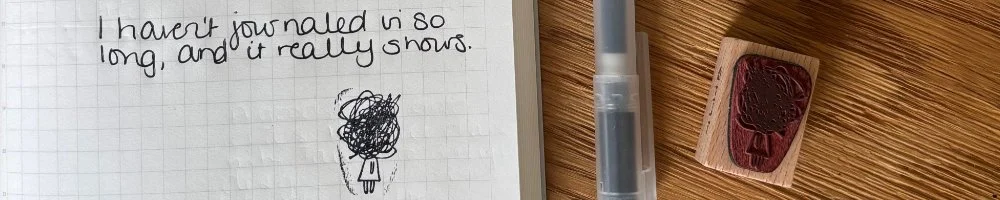
A sustainable journaling practice is not necessarily one you do every day. It is one you feel able to return to. Sometimes, when I miss a long patch - as I did recently, I write something to acknowledge the gap (this week I wrote" : "I haven't journaled in so long, and it really shows") and then stick in photos of highlights from that gap of time, to remember the good things that have happened before I restart my journaling from today.
Not every entry needs to be profound
It is easy to think journaling should involve deep reflections and important realisations. But most of life is made up of ordinary things. Work. School runs. Dinner. Conversations. Weather. Cups of tea. Something funny your child said. A song you cannot stop listening to. Those things are worth recording too.
Try writing down:
Something that made you smile.
One moment you want to remember.
How you are feeling today.
Something you are looking forward to.
A small thing you are grateful for.
You do not have to turn every entry into a lesson. Sometimes noticing your life is enough.
Make journaling fit around your life
There will be times when you have plenty of space to journal and others when ten quiet minutes feels impossible.
Your journaling practice can change with you.
On busy days, try:
Three sentences before bed
What happened, how you felt and one thing you want to remember.
A five-minute journal
Set a timer and write until it finishes.
One good thing
Record one small moment from the day.
A weekly catch-up
Forget daily journaling and write once a week instead.
A simple list
Today I’m feeling…
Thinking about…
Grateful for…
Looking forward to…
There is no minimum word count.
Give yourself permission to make a messy page
If perfectionism is stopping you from beginning, try making the page imperfect on purpose. Write in your everyday handwriting. Cross something out. Use whichever pen happens to be nearby. Start halfway down the page. Leave the page undecorated. You have not ruined your journal. You have used it. A well-loved journal will change as you fill it. The leather will soften, pages will crumple, handwriting will vary and the occasional coffee mark may appear. All of it becomes part of the story.
Keep it small
Sometimes we imagine journaling requires the perfect moment: a quiet house, plenty of time, a beautiful desk and exactly the right words. That moment does not always arrive (especially during the summer holidays if you are a parent)! Instead, make journaling easy to begin. Keep your journal somewhere you can see it. Leave a pen nearby. Give yourself permission to write for just five minutes. A few honest lines are enough.
When you don’t know what to write
Start with what is already here.
Try one of these simple prompts:
What has been on my mind lately?
What is one small moment from today I want to remember?
How am I feeling right now?
What has felt good recently?
What am I looking forward to?
What would I like a little more of this week?
Or simply begin with:
Today…
And see where the page takes you.
There is no perfect way to journal
You can miss days.
You can write one sentence.
You can fill ten pages.
You can decorate everything beautifully one week and use nothing but a biro the next.
You can write about something deeply meaningful.
You can write about what you had for lunch.
There is no correct way to keep a journal. So if perfectionism has been keeping you away from your pages, open your journal today and write something small. Not beautifully. Not profoundly. Just honestly. That is enough.
Frequently Asked Questions
Do I need to journal every day?
No. Journal as often as feels realistic for you. Daily, weekly or occasionally can all be valuable. If you’d like to know more about developing a daily journaling habit, try reading this previous blog post : BUILDING A DAILY JOURNALING HABIT (THAT ACTUALLY STICKS)
What should I do if I miss several days?
Simply start again on the next blank page. There is no need to catch up unless you want to.
How do I stop worrying about perfect journal pages?
Treat decoration as optional. Write first, using your normal handwriting and whatever pen is nearby. Your journal does not need to look polished to be meaningful.
What can I write when nothing interesting happened?
Write about the ordinary details: something you noticed, how you felt, what made you smile or something you want to remember.
How can I journal when I’m busy?
Keep it small. Try five minutes, three sentences, a short list or a weekly journal session instead of expecting yourself to write every day.
